Free during the beta. Atlascope is in development: join now and use all nine tools at no cost.Request access

Sorbet · ELISA, protein and viability assays

Analyse an ELISA, a protein assay or a viability plate

Drop the export of your plate reader: Sorbet fits the standard curve and gives a concentration for every sample, with a report to print. Twelve kits built in.

Request access Open Sorbet

Version 4.1.0, released 9 November 2026. One account for the whole suite; during the beta, access is switched on by hand, usually within a day.
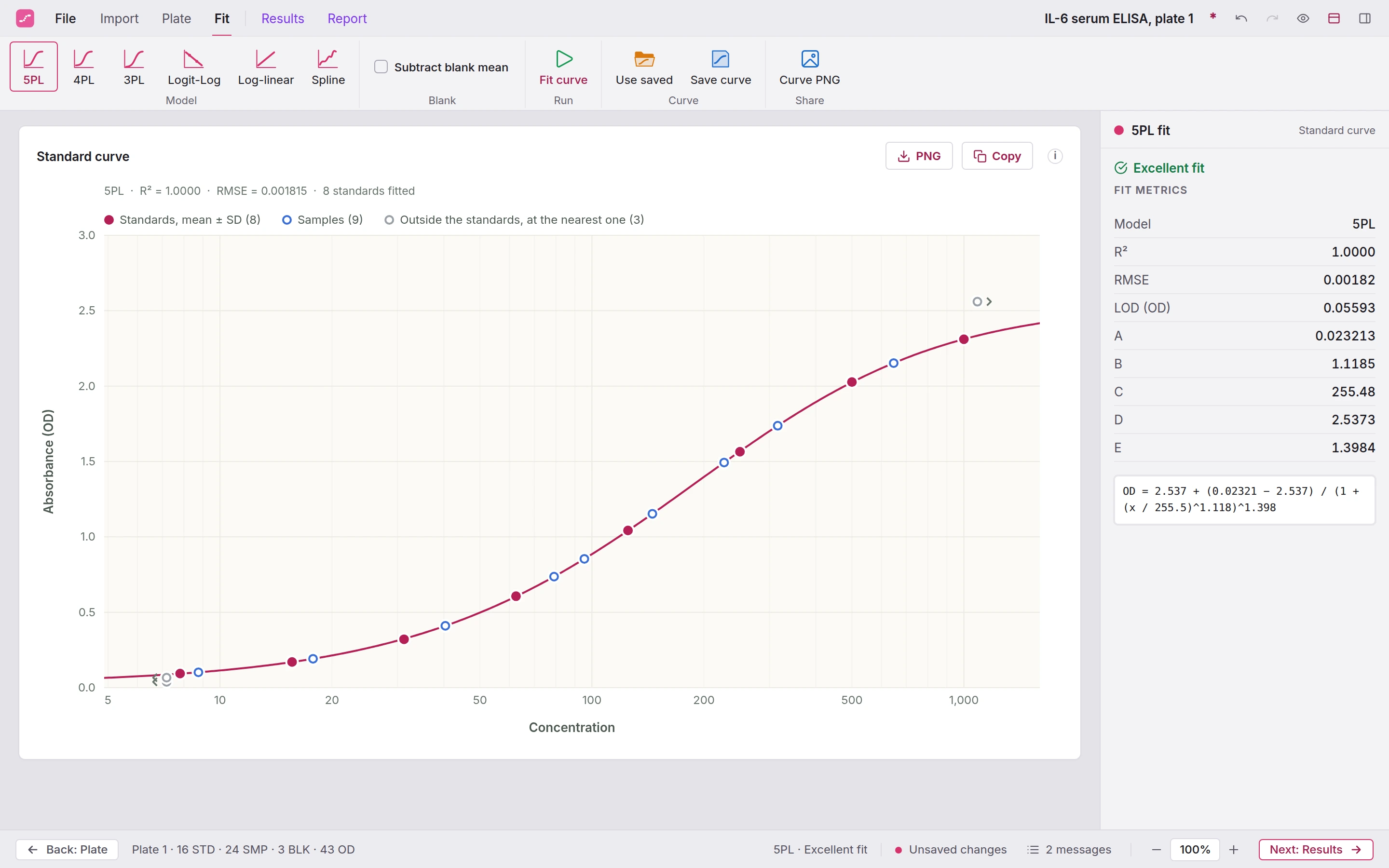
Sorbet after fitting an IL-6 ELISA: the Fit ribbon with the 5PL, 4PL, 3PL, Logit-Log, Log-linear and Spline models, the standard curve with eight standards and nine samples, three samples outside the standards at the nearest one, and the fit metrics with R squared 1.0000, the limit of detection and the full equation.
An IL-6 ELISA fitted with a 5PL curve.

Sorbet

What it does

Three example plates open with the app: an IL-6 ELISA, a Pierce BCA and a CCK-8.

Start · the assay first, then the file

An ELISA, a protein assay or a viability plate

Choose the assay, and the kit brings its standards, its wavelength and its curve model.
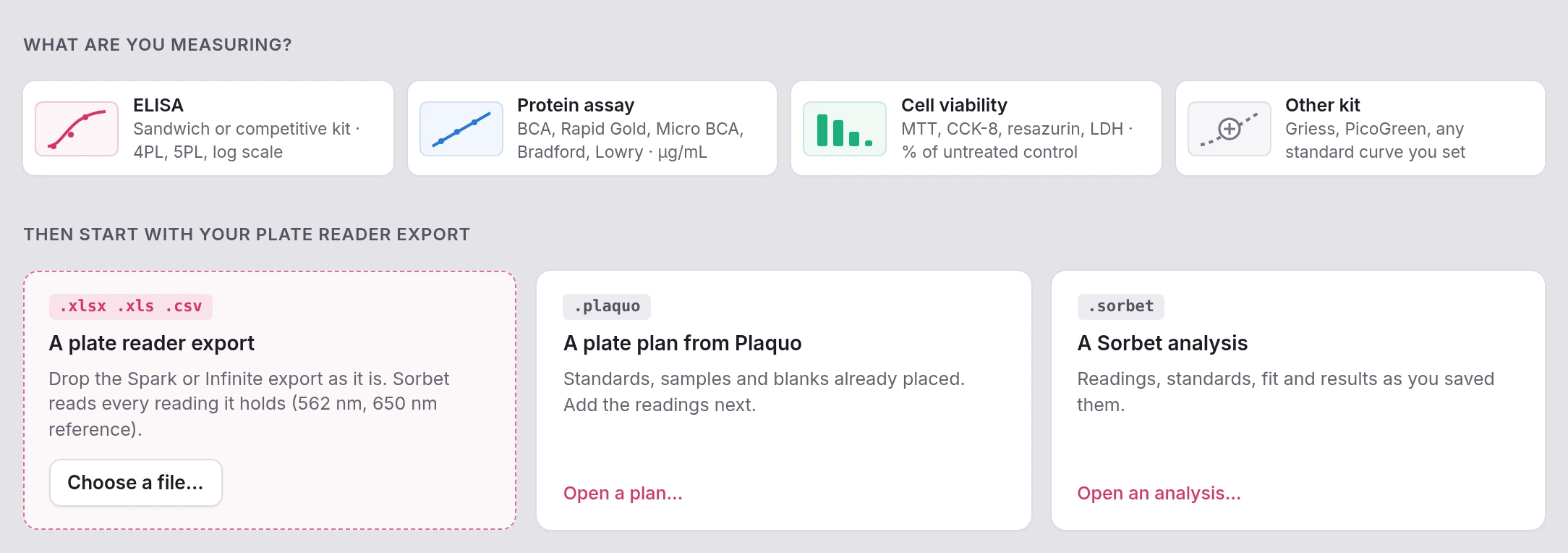
The Sorbet home page: What are you measuring? with four choices, ELISA, Protein assay, Cell viability and Other kit, each with the kits it covers, then the three files Sorbet opens: a plate reader export, a plate plan from Plaquo and a Sorbet analysis.
The home page

Plate · select wells, give them a role

The concentrations written in the wells

Select wells, give them a role, and the concentrations of the standards are written in the wells.
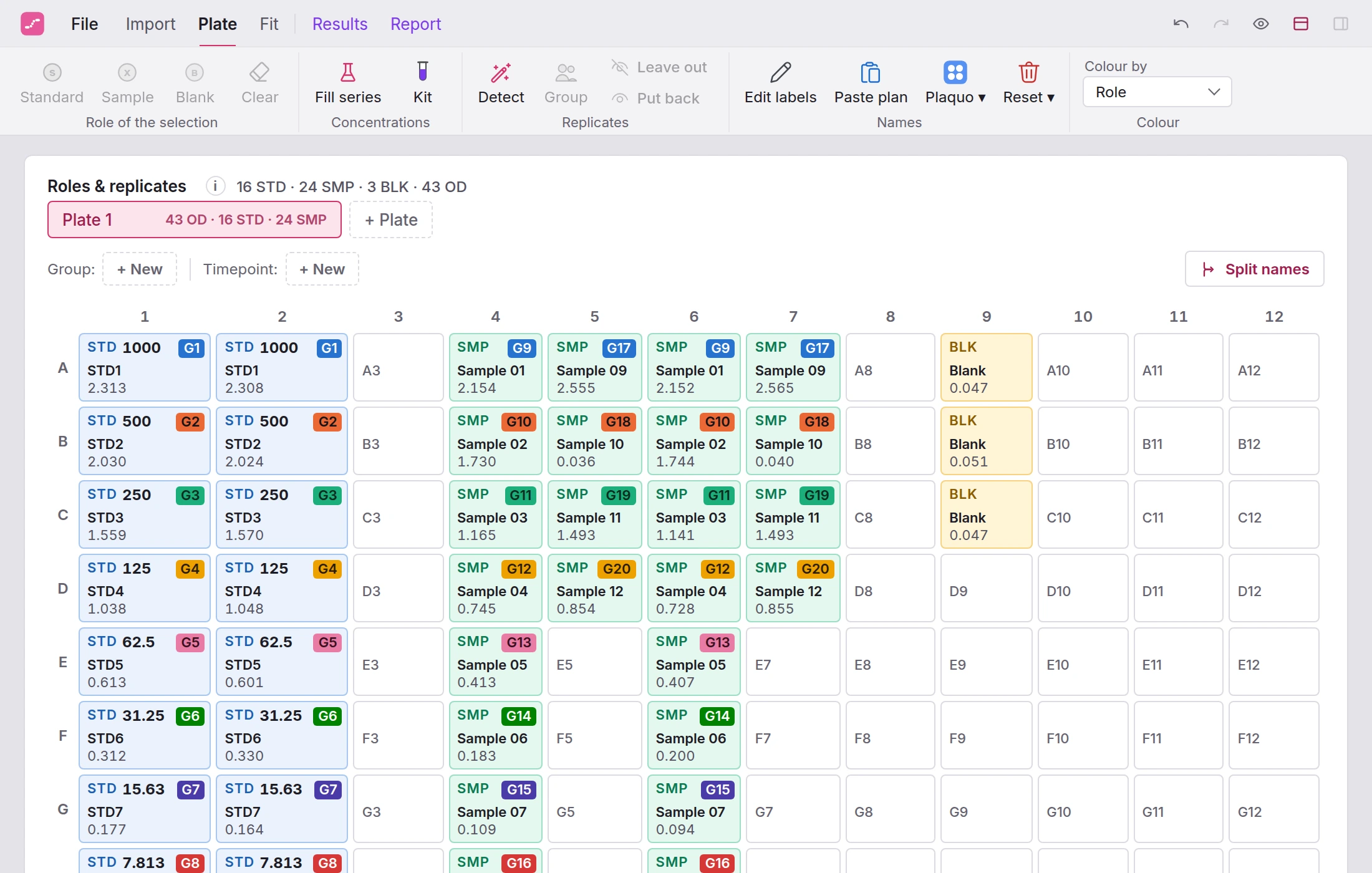
The Plate tab of the IL-6 ELISA: the ribbon with Role of the selection, Fill series and Kit, Detect and Leave out, and the plate below it, standards in blue with their concentration from 1000 down, samples in green, blanks in amber, each well with its name, its optical density and its replicate group.
The plate of the IL-6 ELISA

Protein assay · Pierce BCA, nine BSA standards

A protein assay read the way the kit insert says

A BCA fits a quadratic curve, and each standard is read back against its nominal value.
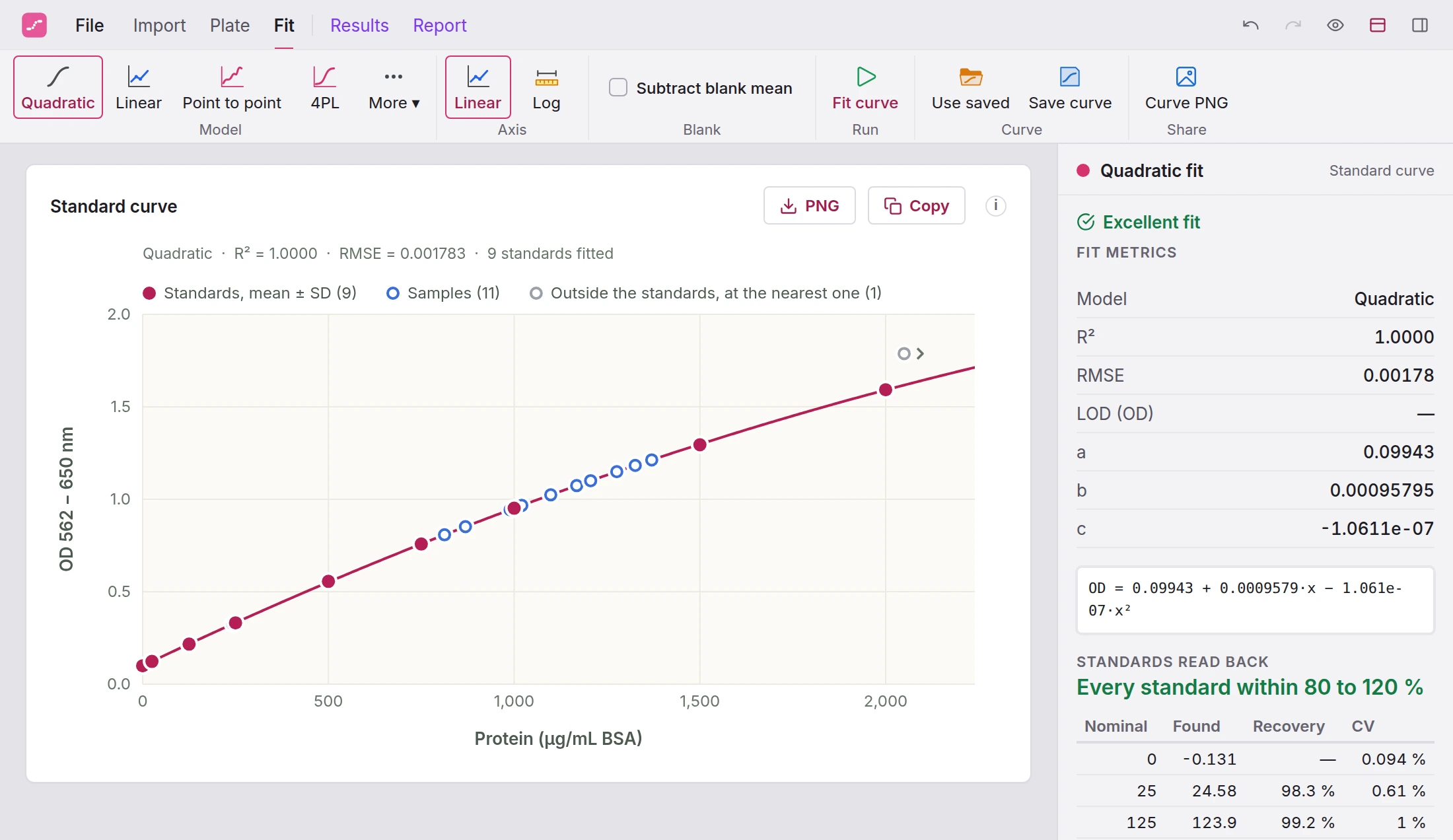
The Fit tab of the Pierce BCA example: the Quadratic, Linear, Point to point and 4PL models in the ribbon, the curve of nine BSA standards read at 562 minus 650 nm with eleven lysates on it, and Standards read back, every standard within 80 to 120 per cent of its nominal value.
Pierce BCA, nine BSA standards

Cell viability · CCK-8, six doses in triplicate

Viability as a percentage of the control

No standard curve: the wells are expressed as a percentage of the control you choose.
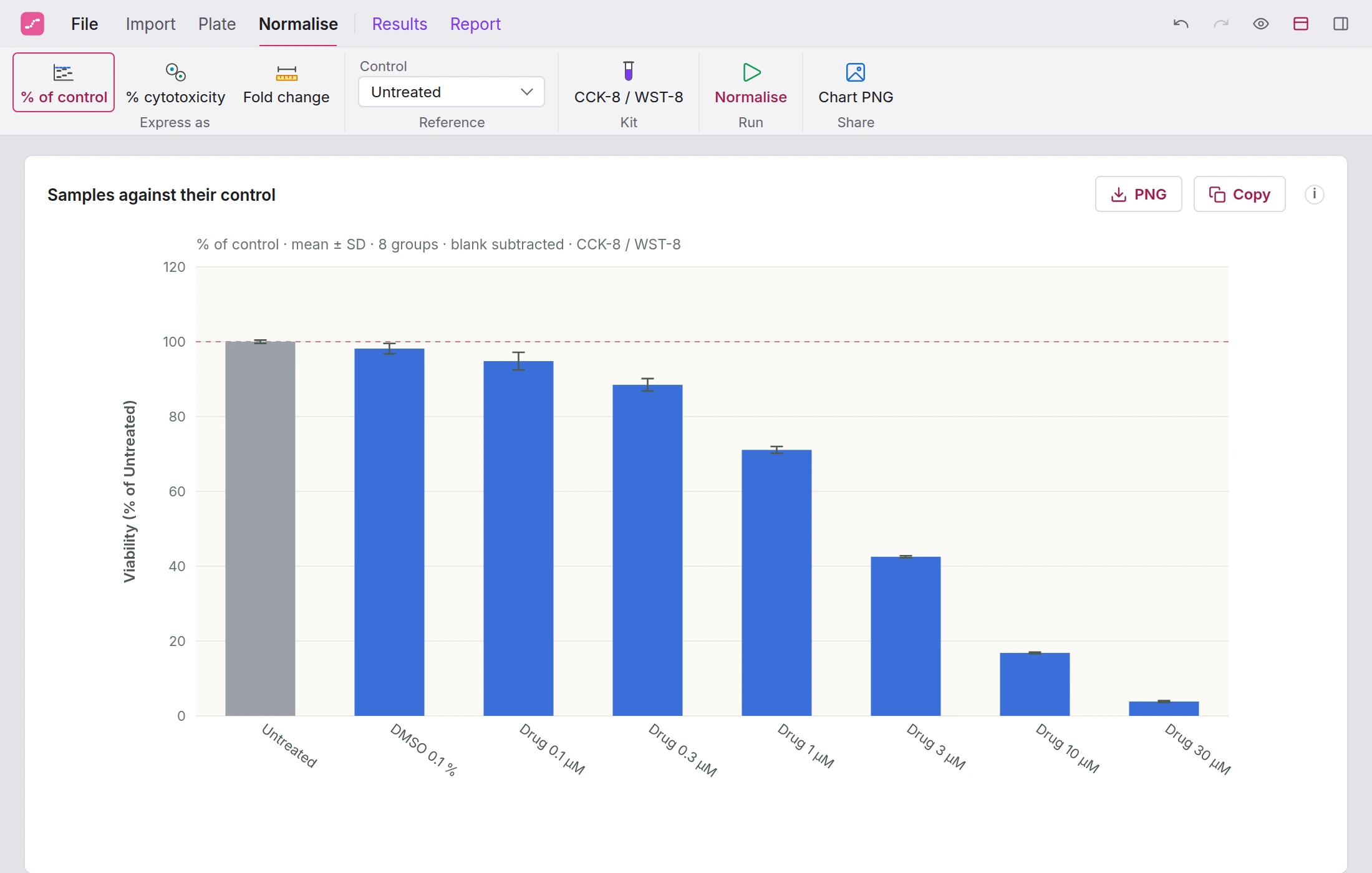
The Normalise tab of the CCK-8 example: % of control, % cytotoxicity and Fold change in the ribbon, Untreated as the control, and a bar chart of eight groups as a percentage of the untreated control, mean and SD, from DMSO at 98 per cent down to the 30 µM dose at 4 per cent.
CCK-8, six doses in triplicate

Version 4.1.0

Specifications

What Sorbet reads, writes and computes, as of version 4.1.0.

Show all 11 specifications
Assays
ELISA (sandwich and competitive); protein assays: Pierce BCA, Rapid Gold BCA, Micro BCA, Bradford (Bio-Rad Quick Start, Coomassie Plus), DC protein (Lowry); cell viability: MTT, CCK-8 / WST-8, resazurin, LDH; other kits: Griess, PicoGreen, or any standard curve you set. Your own kit saves to your account.
Input
A Tecan export (i-control, SparkControl, Magellan) as it is, every reading it holds; plate reader tables as xlsx, xls or csv; a combined file, or the readings and the layout as two files; a grid pasted from Excel; a Plaquo plan (.plaquo); .sorbet and .sorbetcurve.
Output
Results as XLSX or CSV, the curve or the chart as PNG or copied, a report printed or saved as PDF, the plan back to Plaquo, the concentrations to TwistPlot, .sorbet.
Curve models
5PL, 4PL, 3PL, Logit-Log, log-linear, monotone spline; quadratic, linear and point to point for colorimetric kits.
Fit metrics
R squared, RMSE, the full equation, the limit of detection as blank mean plus three standard deviations, each standard read back against its nominal value.
Viability
Blank subtracted, then % of control, % cytotoxicity or fold change against the group you choose, mean and SD per group.
Plates
Roles given to a selection of wells; concentrations written on the standards; replicates grouped from the labels, with a mark above 10 % CV for standards and 20 % for samples; several plates in one analysis; a reading left out, not deleted.
Out of range
A sample outside the standards reads as < or > the nearest standard, extrapolated in italics, or both; n/a with its reason when the curve gives nothing.
Where the data lives
The reader file is read on your computer, not uploaded. The analysis saves to your account or to a .sorbet file, with a draft kept in the browser.
Verification
361 comparisons with R at every build: curves fitted by minpack.lm.
Runs in
A current browser; installs as an app with its own window, where a .sorbet file opens by double click.

What changed

Release notes

Sorbet, last 3 releases. The full list, by tool and by version, is on the release notes page of getatlascope.com.

All release notes

Access

Getting in

Sorbet is one of the nine tools of Atlascope. One account opens all of them. During the beta, we switch new accounts on by hand, usually within a day.

Bring the plate you read this morning.

ELISA, BCA or CCK-8: paint it, fit it, and leave with concentrations and a report that says what was done.

One account for Sorbet and the whole Atlascope suite. If you already have one, sign in. Forgot your password?

Signed in as

Your Atlascope workspace · Sign out

Atlascope

The other eight tools

Same account, same way of working.

All nine tools on getatlascope.com